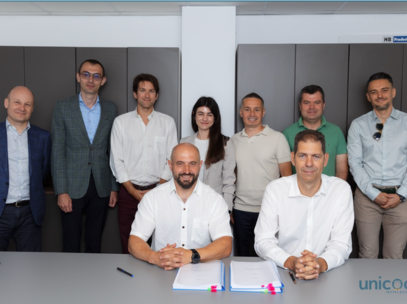
Syclef rafforza la presenza europea e punta sulla Romania con Unicool Group
Agosto 31, 2026
Turning available heat into mechanical energy and using it to produce cooling: this is the principle behind an innovative solid-state refrigeration system developed by researchers at the Karlsruhe Institute of Technology (KIT) and the University of Tsukuba. The study, published in the journal Nature Energy, points to a possible new approach to cooling systems capable of directly exploiting heat sources instead of relying on an electric drive.
At the heart of the technology are two thin films made from a nickel-titanium (NiTi) alloy, a material known for its shape-memory properties.
The first film acts as a thermal actuator. When heated, it changes shape and contracts, converting the energy supplied by heat into mechanical motion. This motion is then transferred to the second film, which serves as the actual cooling element.
This is where the elastocaloric effect comes into play: when the material is repeatedly subjected to loading and unloading cycles, its crystal structure changes reversibly. This phenomenon causes a change in temperature that can be harnessed to remove heat and produce a cooling effect.
“The main innovation lies in integrating two complementary properties of shape-memory alloys: one film converts heat into mechanical work, while the other uses that work to generate cooling,” explained Jingyuan Xu, head of the Young Investigator Group at KIT’s ZEco Thermal Lab.
Prototype Achieves a Temperature Swing of Nearly 13 °C
The initial tests produced encouraging results. With the actuator heated to 86 °C, the device generated a temperature difference of around 4 °C at the component level. In the elastocaloric cooling material, however, the temperature change reached nearly 13 °C.
The experiments also demonstrated that the system could operate using an external heat source at 130 °C, bringing the concept closer to the conditions found in some real-world applications where waste heat is already available.
At this stage, the device developed by the researchers is primarily a proof of concept. Its current configuration has not yet been optimized to achieve maximum cooling capacity.
One of the next objectives will be to increase the system’s output by connecting multiple films in parallel. A larger active surface area could increase the amount of heat transferred and, consequently, improve the device’s overall performance.
From Waste Heat to Electronics Cooling
The ability to use a heat source rather than an electric motor to drive the cycle could make this technology particularly attractive in environments where waste heat is already available.
Potential applications identified by the researchers include cooling processors and electronic components, by harnessing the heat generated during operation. Another possible field of application is vehicles, where heat generated by the propulsion system could be used to help cool onboard electronics.
“We believe this is only the starting point,” Xu commented. The group’s goal is to scale up the technology and develop compact systems capable of exploiting readily available heat sources to provide more sustainable cooling.
The research was conducted in collaboration with the University of Tsukuba and received funding from the Carl Zeiss Foundation, the Baden-Württemberg Foundation, and the Hector Fellow Academy.
The industrial, commercial and logistics refrigeration, frozen-food and cryogenics sectors will come together at REFRIGERA, the international industry event, which will be held at Bologna Exhibition Center from November 10 to 12, 2027.