EU Commission: keep F-gas refrigerants out of PFAS bans
March 4, 2026
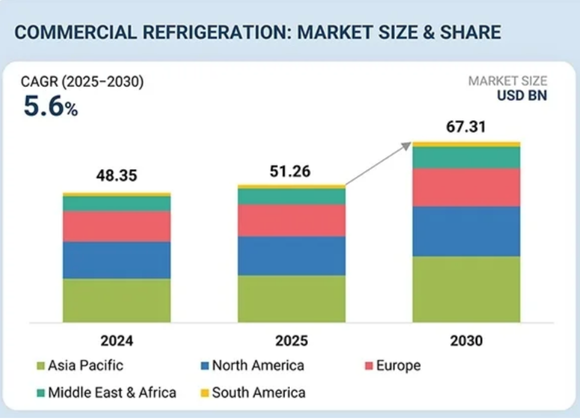
Global demand for cooling is expected to grow exponentially in the coming decades, ushering in a period of rapid expansion for the refrigeration and air conditioning industry. This emerges from the new Global Cooling Watch 2025 report by the United Nations Environment Programme (UNEP), which estimates that global installed capacity could rise from 22 terawatts in 2022 to 68 terawatts by 2050, more than tripling in less than thirty years.
This growth will be driven primarily by rising average temperatures, intensifying heat waves, urbanization, and increasing incomes in emerging countries. Africa and South Asia are identified as the regions with the fastest growth in demand, but the expansion will affect all segments: residential and commercial building air conditioning, industrial process cooling, and cold-chain logistics for food and pharmaceuticals.
For the HVAC&R (Heating, Ventilation, Air Conditioning & Refrigeration) sector, this points to a rapidly expanding market, with millions of new units to be installed and a significant increase in the global stock of equipment.
The report highlights that cooling demand will become a structural factor for electrical grids, particularly during summer peaks. This entails investments in infrastructure, high-efficiency technologies, hybrid systems, and integrated building-plant solutions. Manufacturers and installers will find substantial opportunities not only in supplying new equipment but also in retrofitting existing systems, adopting low-GWP refrigerants, and integrating with renewable energy sources.
Technological Innovation as a Key Driver
Another critical area is the cold chain in developing countries, where limited access to refrigeration leads to food losses and difficulties in distributing medicines. Expanding refrigeration infrastructure represents a long-term industrial driver, with direct impacts on food security, healthcare, and economic development.
From an economic perspective, UNEP estimates that a sustainable cooling trajectory could generate up to $17 trillion in cumulative energy savings by 2050 and significantly reduce the required investments in electricity grids. For the sector, this means that technological innovation—in efficiency, digitalization, hybrid systems, and integrated passive solutions—will be the true competitive factor.
The message for the industry is clear: cooling is no longer a secondary segment but an essential infrastructure in a warmer world. The projected growth in global installed capacity outlined by Global Cooling Watch 2025 represents not only a climate and energy challenge but also one of the largest development opportunities for the refrigeration sector over the next thirty years.
The world of industrial, commercial, logistics, freezing, and cryogenic refrigeration will gather at REFRIGERA, the international event for the sector, to be held at BolognaFiere from November 10 to 12, 2027.
Subscribe to our newsletter and follow us on social media for the latest industry news and updates on REFRIGERA 2027!